Skip to content
Kat Wall Rural Texas

Five fights that decide whether rural Texas keeps working.

Five places where the policy is moving right now, and where she’s already in the room.

Positions as of June 2026

01

The beef squeeze

Four companies run about 85 percent of American beef processing. One of them is headquartered in Brazil. The rancher takes the price he is handed and the family pays what it’s told, while the margin disappears in the middle.

For thirty years Washington let beef processing collapse into four firms. When a rancher has a handful of buyers for his calves, he has no leverage. When a shopper finds the same few processors behind nearly every package on the shelf, neither does she.

The American cattle herd has fallen to roughly 86 million head, the lowest since 1951. More than 150,000 ranching operations have been lost since 2017. Drought did some of it, costs did some of it, and consolidation pushed independent operators off the land for good.

Conservatives believe in competition, and four firms running an essential industry is the opposite of it. This is the cronyism we’re supposed to oppose, dressed up as a market. Put more buyers in the ring for a rancher’s calves and the price finds its own level. That’s the market doing its job.
What she’s doing about it

  • Making the case for honest labels, so an American label means the animal was born, raised and processed here.
  • Backing lower inspection fees and real access to loans for small and regional packers.
  • Pressing to bring down the state rules and fees that keep a local meat plant from opening. More buyers for the rancher.
  • Standing against foreign conglomerates buying up Texas farmland and agricultural infrastructure.

02

Texas is running dry

The Edwards Aquifer ran under emergency pumping cuts without a break from 2022 until this summer, and in May 2025 it hit Stage 5 for the first time in its history, a 44 percent cut. Rain has eased it back to 30 percent and everybody exhaled. Rain is not a water plan.

Up in the Panhandle the Ogallala, the largest groundwater reserve in the country and the thing that grows the nation’s beef and cotton, is being drawn down faster than it will ever refill. Closer to home the Carrizo-Wilcox sits under a long list of rural communities that have no second option.

Texas voters did their part. In November 2025 they passed Proposition 4, dedicating up to a billion dollars a year to the Texas Water Fund from 2027 through 2047 without raising a single tax. The money is no longer the hard part. Spending it on results is.

Fix the leaks first, because repairing aging pipe is the cheapest new water there is. Then supply: reservoirs, reuse, desalination. And water stays property. Local control and landowner rights come before any plan drawn in Austin.

What she’s doing about it

  • Pushing Proposition 4 money toward pipe and storage, and pushing the state to publish what each dollar bought.
  • Working to move rural systems and aging distribution lines to the front of the queue.
  • Defending the landowner: no statewide grab of a working well, no quiet transfer of a rural lake.
  • Sitting down with water researchers on groundwater management, surface water and reclamation.

03

The reactor America walked away from

America invented the molten-salt thorium reactor at Oak Ridge in the 1960s and then shelved it for fifty years. China picked up exactly what we put down, and in November 2025 bred fresh fuel from thorium. It’s the only thorium-fueled reactor operating anywhere.

Energy is the floor under everything else Texas wants to be, and Texans haven’t forgotten Uri. As the population grows and industry pours in, the state needs more power that runs around the clock in any weather.

Texas is already moving. House Bill 14 stood up the Texas Advanced Nuclear Energy Office with a $350 million fund that can scale toward two billion. Out in Abilene, Natura Resources and Abilene Christian University are building the first molten-salt reactor the Nuclear Regulatory Commission has ever licensed, and construction is due to finish this year.

The pieces are here. Kat Wall is an energy executive at Texas Thorium, working with Texas A&M on thorium power. The case is reliability, jobs, independence, and keeping a technology America invented from ending up China’s alone. It sits alongside Texas oil and gas.

What she’s doing about it

  • Pressing to cut the state-side red tape so Texas projects reach construction instead of committee.
  • Making the workforce case. Nearly 1.7 nuclear workers retire for every one entering the field.
  • Defending the whole Texas energy stack: oil, natural gas, lignite, geothermal and advanced nuclear.
  • Building the thorium work here, so the research and the manufacturing jobs stay in Texas.

04

Rural Texas gets the leftovers

Rural roads, rural water systems and rural power lines deserve a larger share of state infrastructure money than they get. The formula follows population, which puts the counties that feed the state last in line for the money that keeps them running.

A farm-to-market road is how the cattle get to the sale barn, how the harvest gets to the elevator, how the ambulance gets to the house and how the school bus gets home. When it goes, everything on top of it goes with it.

The same is true of a small water system running sixty-year-old pipe, and of a distribution line that takes four days to restore after a storm. Those are the conditions for anybody to live and work out here at all.

Fixing them is unglamorous, which is exactly why it keeps getting deferred. It’s also the cheapest work on the list, because deferred maintenance never gets less expensive.

What she’s doing about it

  • Arguing for a larger portion of state infrastructure funds to reach rural road maintenance.
  • Making the case that rural water and power distribution belong in the infrastructure budget with a line of their own.
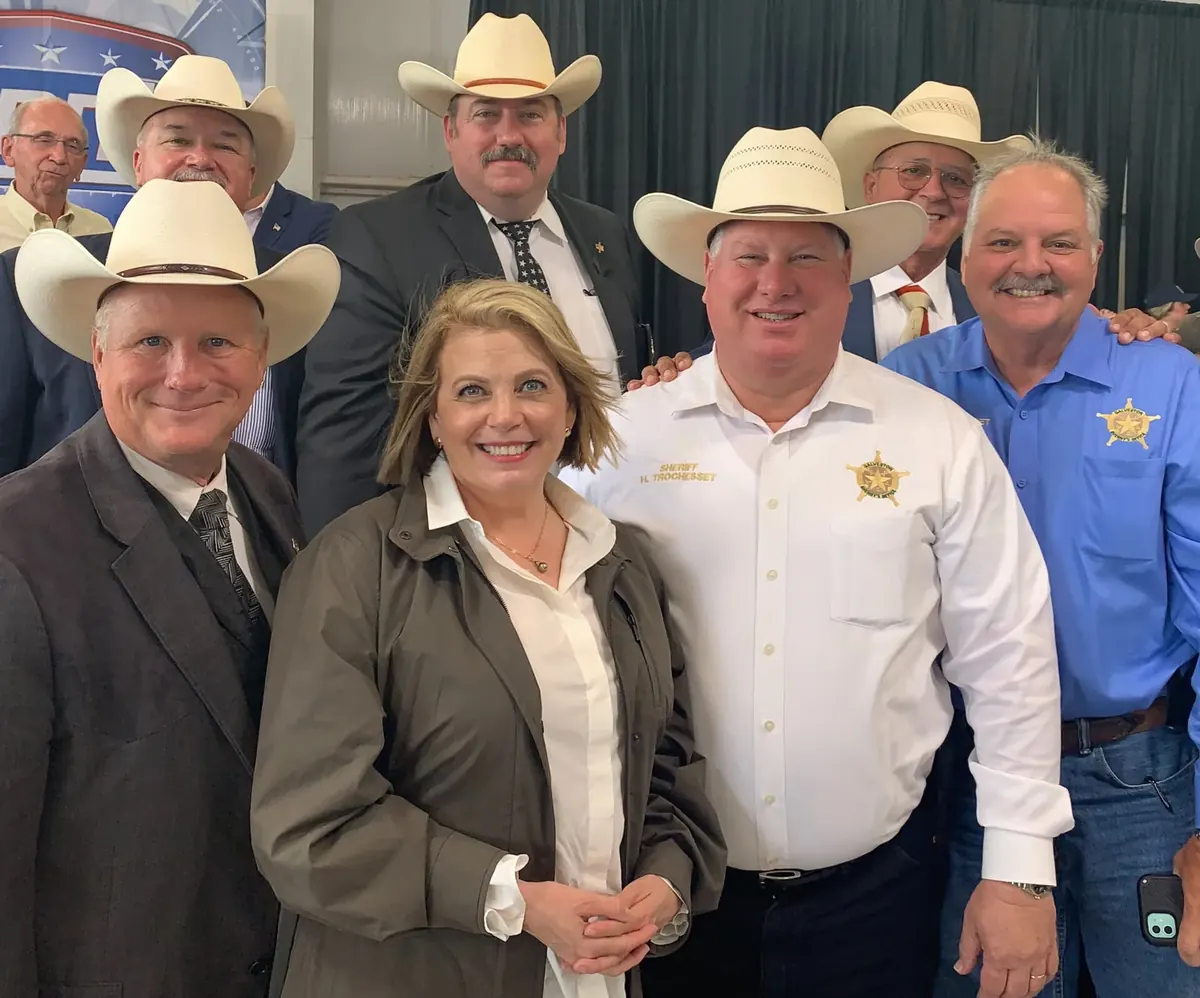
  • Working with sheriffs and local law enforcement on the safety standards those roads are supposed to meet.
  • Pushing the maintenance that keeps communities connected ahead of the projects that photograph well.

05

Decisions made closest to home

Government works best when the decision is made at the level closest to the citizen. Nobody out here likes Washington imposing its will on Texas, and the objection doesn’t change when the imposing is done from Austin.

That principle is being tested by what wants to be built in rural counties. Heavy industry and data centers arrive needing enormous amounts of water and power, and the county supplying both is often the last one consulted.

Growth is welcome here. The people whose aquifer and whose grid are being drawn on should have a real say in the terms, and the terms should be written down before ground is broken.

Local control is also how rural Texas defends everything else on this list. Water rights, land use and what gets sited next door are the decisions that determine whether a county still works in twenty years.

What she’s doing about it

  • Defending county and landowner authority over land use and siting.
  • Pressing for large new water and power demands to be accounted for before approval, not after.
  • Pushing back on state and federal mandates that override local judgment about local ground.
  • Working to reduce the regulations that hinder rural growth without handing the county to whoever arrives first.

She has been in these rooms a while.

August 2025

Backed the Carrizo-Wilcox aquifer study

Praised Governor Abbott for adding a study of the Carrizo-Wilcox Aquifer to the special session call, after meeting water policy researchers in Austin about groundwater management, protecting surface water from overuse, and reclamation.

As I’ve traveled throughout House District 13, I’ve heard numerous concerns regarding our precious water resources. Specifically, I’ve seen the great concern about taking water from Lake Limestone …

Kat Wall, August 2025

October 2025

Stood with ranchers in Washington

Attended the announcement of the USDA Plan for American Ranchers and Consumers, which covers Product of USA labeling, reduced inspection fees and expanded loans for small producers, and help for young and veteran ranchers.

Texas ranchers are hurting. Over 150,000 ranching operations have been lost in America since 2017, and the national herd is at a 75-year low. Yet demand for beef continues to rise.

Kat Wall, October 2025

Where these numbers come from.

Figures verified against reporting through September 2026. Drought stages and market prices move, so the dated ones are dated on purpose.

Beef

  • Big Four control roughly 85 percent of U.S. beef processing; DOJ antitrust probe announced May 2026.MEAT+POULTRY
  • Herd near 86.2 million head, lowest since 1951.The Cattle Site, NPR
  • Country-of-Origin Labeling Enforcement Act, H.R. 5818.Congress.gov

Water

Power

Push these forward.

These fights get won by people who show up in county rooms and legislative hearings. Tell us where you are.

I want to help by

By giving your phone number you agree to receive recurring text updates, including automated texts, from Kat Wall and from any campaign committee she establishes. Message and data rates may apply and frequency varies. Reply STOP to opt out or HELP for help.